Google added new data integration tools to its Data Manager platform, which will help target promotions and drive improved response through artificial intelligence-powered recommendations.
Google’s Data Manager is a centralized platform where advertisers can upload and manage their owned data, using their own customer and sales info in Google ads.
With this update, Google is expanding the capacity to utilize these insights in more ways. The change should help better guide AI-powered targeting tools via actual audience and conversion insights.
First, Google launched a new integration that will feed Data Manager info into both Google Analytics and Display & Video 360. The expanded data sourcing will provide enhanced audience insights and help drive more accurate ad display options.
The company said this can drive significant performance improvements.
“Advertisers who connect offline and app data to Data Manager see an average 26% increase in incremental ROAS,” Google said.
In addition, Google is rolling out enhanced conversions in Google Analytics and Display & Video 360. This will provide another means to match customer data and improve advertising performance.
Google also expanded the connective options in the Data Manager API, which will enable more businesses to connect their data sources.
As explained by Google: “Based on the IAB Tech Lab’s Event and Conversions API (ECAPI) standard, the Data Manager API gives you a unified, secure setup to connect, manage, and activate your audiences and measurement across major ad platforms. And new built-in diagnostics in Data Manager can automatically identify and address data issues before they impact campaign performance.”
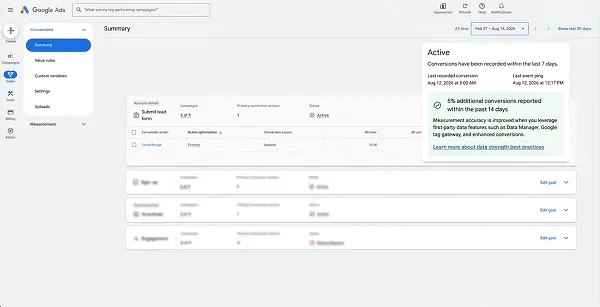
The company also launched a Data Strength Uplift Metric in Google Ads, which will calculate any additional conversions attributed to first-party data sources to better quantify impact.
In addition to more data input options, Google also updated its Meridian data portal, which provides another means to measure ad performance, using Marketing Mix Modeling to measure ad impact.
Google is adding AI-powered agentic capabilities into Meridian to make it easier to audit data quality, resolve errors and guide model building in real time.
Meanwhile, the company is incorporating more brand signals directly into Meridian models and expanding access to its GeoX library for running causal geography-based experiments.
In combination, Google said that these expanded data intake and assessment tools will provide more insight to power its AI models and drive improved recommendations for ad approaches.