Instagram announced an expansion of its Your Algorithm topic preference feature to the main feed, which will give users more ways to control what they’re shown in the app.
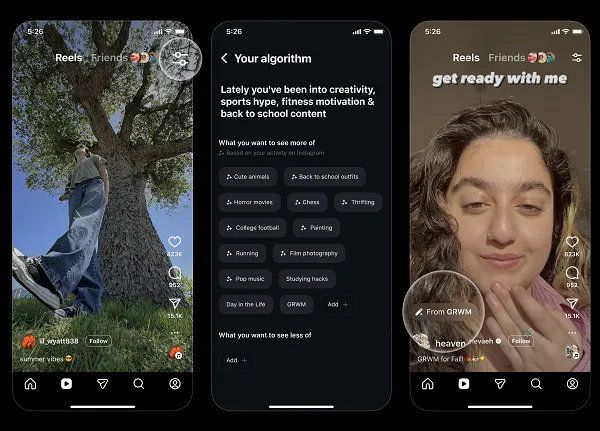
The update will give IG users a means to tell the system what topics they actually like, and what they don’t.
Users can choose from a list initially populated by Instagram’s system, based on their in-app activity. Any changes to this list will then help the system revise the algorithmic parameters assigned to each user.
Instagram launched an initial test of Your Algorithm for Reels in October 2025, then expanded that to the Explore feed in April. Now, the app will enable users to have some say over what’s shown in their main feed as well, providing another customization and control option for users.
It’s a significant update, while it’s also likely to be a PR win, in that it addresses users’ desire to manage their in-app experience, as opposed allowing algorithms to dictate what users see.
People won’t use it, of course, but having it as an option seems to quell a lot of chatter on this front.
Interestingly, Instagram Chief Adam Mosseri has penned an overview of the state of algorithm-defined social media, which discussed where he sees things headed in terms of user agency.
Mosseri said the shift to artificial intelligence-powered recommendations has eroded user control, which has in turn diluted the social and personal elements of the experience.
As per Mosseri: “[W]ho you follow used to be a meaningful tool people had for shaping their own experience, and as recommendations took over the main feed that tool quietly stopped working. The conversation with the system became one-sided. The system learns from what you tap, watch, and share, but you don’t really get to tell it what you want. I think this is part of what people feel when they feel uneasy about social media — not the content itself, but the sense that the experience is happening to them rather than being shaped by them.”
Mosseri said that AI systems have refined this to some degree, by expanding the ways in which systems can categorize content, enabling broader matching to user interests. But it remains a largely automated process, which lessens personal input.
Though Mosseri said he suspects that will change in future, with AI tools able to further personalize in-app experiences.
“Within a few years, AI will be capable of not only letting us see and shape algorithms, but also generating entire bespoke experiences on the fly, tailored to an individual in real time,” Mosseri said. “At that point you can imagine shaping much more than how ranking works in an app like Instagram — the structure of the app itself, the experiences inside it, even the things the app is for could be different for each of us.”
Conceptually, Mosseri believes that AI tools will re-create what we understand as user experience, and enable more customization. Though it’s interesting to note that Mosseri is making this point as if Meta won’t look to exert control over all of these elements in order to maximize time spent in its apps.
Which is why Your Algorithm is also something of a risk. AI-powered recommendations now drive all of the gains in user engagement across Meta’s apps, and ceding any of that control back to users is uncharacteristic for a company that’s repeatedly established that maximizing user engagement is its North Star, no matter the cost.
If a lot of IG users update their algorithmic recommendations, that could impact overall usage, because all of the data suggests that algorithms, whether people like them or not, drive higher usage in social apps.
The bet Meta is making here is that people won’t bother to update their topics, and that users won’t actually take action on such, even when they can, and despite loudly calling for more input into the system.
In this sense, algorithmic editing tools such as this act more like an assurance element than a practical tool, because social apps know that, in the end, what users really want is convenience.
That convenience, in the modern social media era, means that people now expect that social platforms will take cues from their in-app actions, in order to shape their experience around their expressed interests.
This is also interesting in the context of Mosseri’s comments. Despite all the historic evidence showing that people will gravitate towards the systems that best automate and simplify the display experience, Mosseri is suggesting that AI will eventually enable more customization and control.
It’s unlikely people want this. However, many would say they do, and a lot of users may find it interesting to have the capacity to build an Instagram experience that better aligns with their usage.
But they won’t use that function.
People have come to expect that smart systems will understand their interests, and refine the content displayed to them based on their activity. If social apps don’t do that, users will find another app.
It’s interesting that developers such as Mosseri view AI as a means to build, yet all evidence suggests that most people are seeking the simplest process possible that will enable them to sign-up to an app and start scrolling, without going through all the settings and options.