Meta advertisers may soon lose one option when setting up their campaigns, with the company alerting advertisers that it will soon be removing the Placements option from ad sets.
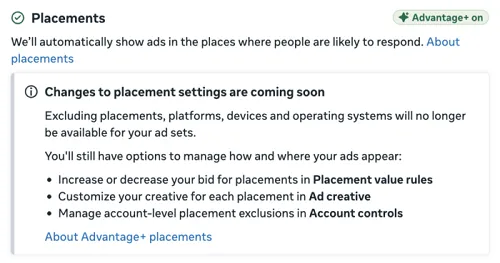
As shown in this image, shared by Meta ads expert Jon Loomer, some Meta advertisers are being alerted that changes are coming to their ad targeting options, though no timeline has been announced yet.
Meta’s ad placements option enables advertisers to exclude certain Meta ad placements from their campaign. That means if an advertiser doesn’t want their ad shown in search results on Facebook, or via in-stream ads between Reels, they can choose to opt out of these placements. The feature gives marketers more control over their brand presence across Meta’s apps.
But soon it seems they’ll lose that option. Meta is pushing advertisers to expand placements in order to let its automated system choose the most responsive display options for each promotion.
But it’s not just placements. Loomer also noted that Meta is additionally removing the option to exclude platforms as well. That means that Meta’s system will be able to display ads from each campaign across any apps, based on a systematic assessment of where the ad will best perform.
It’s another step towards Meta’s longer-term vision of fully automating ad campaigns. The company’s artificial intelligence-powered ad system will eventually be able to undertake the whole ad creation and placement process, with the advertiser only having to enter a URL to launch a campaign.
Last year, in an interview with Ben Thompson of Stratechery, Meta CEO Mark Zuckerberg outlined this plan: “We’re going to get to a point where you’re a business, you come to us, you tell us what your objective is, you connect to your bank account, you don’t need any creative, you don’t need any targeting demographic, you don’t need any measurement, except to be able to read the results that we spit out. I think that’s going to be huge, I think it is a redefinition of the category of advertising.”
Conceptually, the current AI tools should be well-equipped for this, because while the tools are not actually thinking for themselves, they’re good at large-scale analysis and pattern recognition.
AI systems, with their expanding processing capacity, are able to analyze and interpret user queries much faster than anything that’s come before, assessing a wide range of complex elements to provide the most relevant answer, based on data matching.
That should mean that they’re particularly suited to understanding what types of ads each person is likely to respond to, and then creating personalized ad messages that best align with performance trends.
That should drive better results, and Meta has been gradually guiding its ad partners towards this level of automation over the past couple of years.
Removing more ad creation options is another step. This may eventually reduce advertisers' input to the point where they’re being asked to rely on Meta’s systems to undertake that work for them.
That will mean handing over a higher level of control to Meta’s system, but if the results are there, it could be a better process.
The next concern then will be ads becoming too similar, which will not only impact current ad exposure, but will also drive future data inputs.
If all ads are automated, then the system will create new ads based on its own generations, which could erode effectiveness.
No doubt Meta has options in place to avoid this.