LinkedIn has shared some new insight into its evolving battle against AI slop, as the platform works to stem the flood of repetitive artificial intelligence-generated content that’s steadily eroding its in-app experience.
In August, LinkedIn added a new option that let users report instances of suspected AI-generated content in-stream. More specifically, this feature targeted AI slop, which LinkedIn defines as generic and/or repetitive posts that added no real insight.
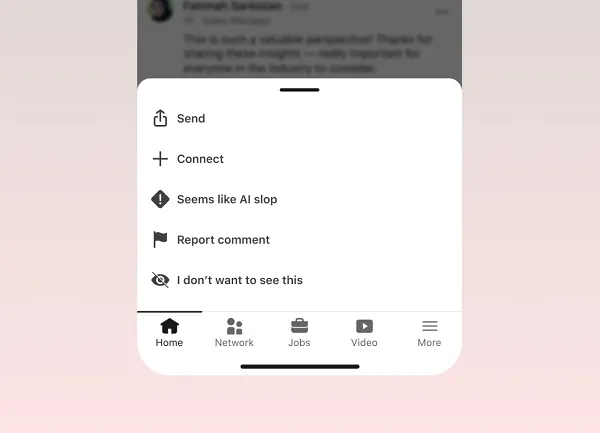
The option immediately proved popular, with LinkedIn reporting that less than three weeks after launch, more than 1 million people had used the feature to weed out AI junk and clean up their feed experiences.
On Oct. 8, LinkedIn VP of Engineering Tim Jurka shared a post that offered more insight into the internal definitions of AI slop, how LinkedIn wants to get better at detecting such and the impact that this process had thus far.
First, Jurka outlined the platform’s AI slop identification process, in which the platform uses feedback from the AI slop button to train its systems on what to look for.
As explained by Jurka: “Specifically, we use what’s known as a teacher-student setup. The larger ‘teacher’ models are designed to keep up with new AI-slop patterns and accurately identify them, which generates the high-quality training data we need to ‘teach’ or train our smaller models to pick up on those new patterns rapidly.”
So like Thanos using the Infinity Stones to destroy the Infinity Stones, LinkedIn is using AI to detect AI slop, training its model on evolving definitions of what qualifies as repetitive junk.
Jurka said that LinkedIn has deployed a range of AI agents that are assigned a specific policy. These bots evaluate content based on a strict set of parameters aligned with that rule.
“Each agent is guided by a specific policy, which defines the criteria it uses to evaluate content, such as whether a post is promotional, celebrates an achievement, or is timely,” he said. “When an agent comes across a complicated example it doesn’t fully understand how to reason about it in the context of a policy, it can surface that example to our human reviewers, learn from the guidance they provide, and evolve its policy to better handle similar situations in the future.”
That creates a more complex detection web, which is based on human guidance and insights gleaned from user reports in order to better detect AI slop and hide it from view.
Which has driven significant improvement in the detection of AI-generated posts.
“Leveraging both our student-teacher framework and our agentic workflows, we’ve recently expanded our classifiers to cover all posts that are distributed beyond your immediate network with 94% precision at detecting AI-slop,” Jurka said.
LinkedIn previously reported that it reduced views of AI slop by 40%, addressing a clear demand from users to mitigate AI overwhelm.
Which, really, all platforms would probably benefit from.
The rise in AI-generated posts has increased overall skepticism about every post in social media feeds, to the point where it feels like nothing is what it seems. But aside from that, most of the posts are indeed slop. Most posts that include images of video generated by AI are not engaging or interesting, and lack any real sense of human connection or value.
It feels like looking through a scrapbook of ideas pulled from people’s heads that were never meant for public consumption, or viewing half-imagined pastiches highlighted in bright neon colors that give them a headache-inducing effect.
That’s not to say that all AI use is bad, but successful artists have honed and developed their skills over time. They’ve created a style and flow that communicates their concept and recreates the emotion that inspired their vision.
Generative AI lacks this, and without the understanding based on that refinement, its creators often don’t even know why their content is not good. They just post junk, dismiss criticism and feel like they’ve achieved something.
It’s getting to the point where social media is indeed being overwhelmed by AI slop, as many experts had predicted, and demand for an AI off switch is likely going to grow across all social apps.