Meta has taken the next step forward in its evolving artificial intelligence push, with the launch of its advanced Muse Spark 1.1 model. The company said on Thursday that Muse Spark 1.1 will enable advanced AI use cases and opportunities via improved reasoning and automation.
Meta hopes this will help to win over business subscribers as the company looks to introduce paid tiers for developer use.
As per Meta: “Muse Spark 1.1 is a multimodal reasoning model built for agentic tasks, with major gains in tool and computer use, coding, and multimodal understanding. With these improvements, Muse Spark 1.1 advances the performance-efficiency frontier.”
Muse Spark 1.1 is able to maintain context across sessions and adapt to evolving requirements. Meta said the tool can also navigate unfamiliar interfaces with minimal human intervention.
“Rather than reasoning through every desktop step one click at a time, Muse Spark 1.1 understands when to automate and when to use the interface directly,” Meta said. “We trained the model to write scripts when automation is faster, click when direct interaction is simpler, and generate batches of actions at each step.”
Meta said that together with the launch of Muse Image earlier this week, the company is advancing its vision of developing personal superintelligence, with “models that help you pursue your goals, create what you imagine, deepen your relationships, and take action on what you value most.”
Muse Spark 1.1 surpassed many competitors’ AI models in benchmarking tests, including coding and agentic response, Meta added.
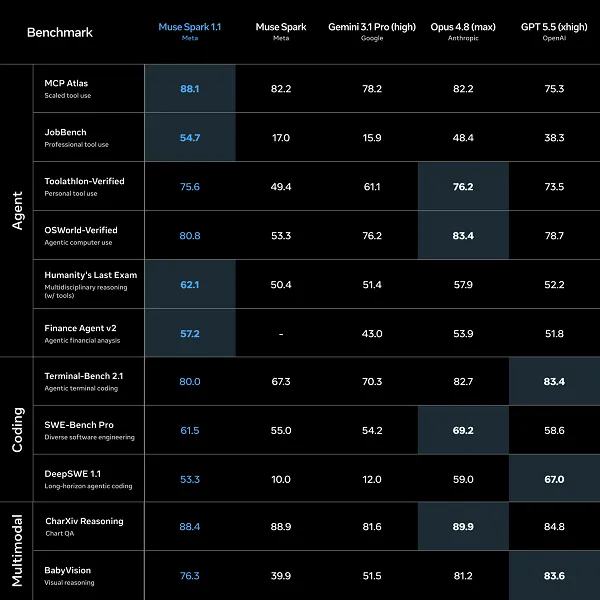
The model’s agentic performance could be especially relevant, because according to Vishal Shah, Meta’s VP of AI products, the company is also developing AI tools that will be able to take action on a user’s behalf in various contexts.
“Muse Spark 1.1 delivers exceptional performance in personal agentic tasks that require planning and orchestration across a range of external apps and services,” Meta said.
This could be problematic, considering the various issues that have been reported with the AI tools already empowered to undertake tasks on behalf of humans.
Meta itself has direct experience with these problems. Last month, reports emerged that Meta’s agentic AI account support agents on Instagram incorrectly granted hackers access to about 20,000 accounts after being asked to do so.
That’s one of many cases where flawed AI logic flows have led to significant breaches or issues, yet Meta seems confident that Muse Spark 1.1 will perform better.
If that’s true, then this could also enable the company to make money from its AI projects.
As reported by Bloomberg, Muse Spark 1.1 will be the first of its AI models that includes a paid tier for developers.
Meta CEO Mark Zuckerberg told Bloomberg the model’s pricing will be “very aggressive and attractive,” as the company looks to establish a more direct link between its massive AI investment and any future revenue potential.
This is quickly becoming a significant concern. Meta has committed hundreds of billions dollars, and possibly more than $1 trillion dollars to AI development in an effort to lead the AI arms race, and the company has said it sees the technology as creating a transformative shift.
But as with all the major AI projects, that level of financial investment means AI is going to have to meet those forecasts in order to turn a profit.
Based on the current expenses tied to its AI projects, it would take more than a decade just to break even on its AI expenditure even if Meta was bringing in $100 billion per year from AI subscriptions. That’s not factoring in ongoing investment and maintenance costs, all of which will push those costs up higher, which means that Meta is going to have to introduce a lot of AI products to lure business and consumer investments.
For the full year 2025, Meta reported about $200 billion in revenue, with around 98% of that coming from ads. The company essentially needs to build its entire business once again, structured around AI, to even have a chance of making money from this AI push.
That’s why Meta is now looking to build monetization pathways, including subscriptions for AI tools and enterprise-level access for its latest AI models. But in order to win people over, it’s going to need to demonstrate that its AI tools are worth significant investment, which is why it’s so keen to show how agentic AI can do the work of human staff.
Even if it can’t.
As Meta’s own use case has shown, there are enough issues and concerns with AI agents to suggest that these models shouldn’t be empowered as business agents just yet.
Furthermore, the latest reports suggest that AI tools aren’t delivering on their promised major business efficiencies.
But Meta is keen to push ahead, and has even promoted its own plans to replace 90% of its content review staff with AI tools by the end of 2026.
This kind of squeeze will likely lead to more problems, as companies invest in AI tools and staff are tasked with implementing these models, whether the tools work or not.