Pew Research published a new report on Oct. 23 that showed that more than half of Americans now consider social media to be a key way to get news and information.
Based on a survey of more than 3,500 U.S. adults, conducted in June this year, the data underlines the significant influence social media platforms have on the flow of information. It also reiterates the role that social media continues to play in terms of how the voting public stays informed of key events.
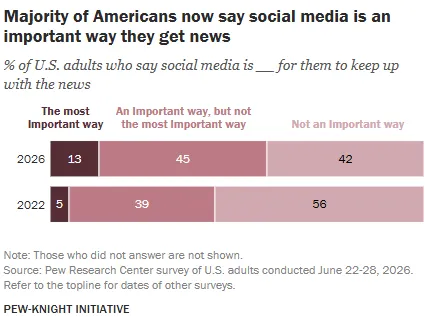
As shown in this chart, 58% of Americans consider social media to be an important connector to current events. Within that, 13% of Americans consider social apps to be their most important information source. Based on the total U.S. adult population of about 270 million, as estimated by the Annie E. Casey Foundation, that suggests that around 35 million U.S. adults now rely on social media to keep them informed.
That’s higher than when Pew Research conducted the same research in 2022. In that report, as cited in the above chart, 43% of U.S. adults said social media was an important way that they got news, while only 5% said that it was the most important news resource.
As noted, the data underlines the growing reliance on social platforms, while also further underlining the power that social networks have to influence media narratives, depending on each app’s policy and moderation approach.
That’s been a key point of contention for some time. Elon Musk, for example, purchased Twitter in 2022 based partly on his own concerns that the Twitter management team had been interfering with democracy by manipulating what posts gained traction in the app.
This type of speculation has coalesced into what some have referred to as the “censorship industrial complex,” which is allegedly a loose collection of activists that has sought to police online behavior by attempting to sway public discourse through crackdowns on speech, and trying to limit what can be amplified within social media apps.
Indeed, in December U.S. Secretary of State Marco Rubio announced that the State Department was taking action against individuals whom it claimed had led organized efforts “to coerce American platforms to censor, demonetize, and suppress American viewpoints they oppose.” That announcement was titled "Actions to combat the censorship-industrial complex."
Given the influence that social media platforms now have, it makes sense that the government wants to ensure that they remain free and open to all perspectives. Yet, at the same time, allowing information to flow through these platforms, enabling potentially huge amplification of any claims, can facilitate the spread of misinformation and false narratives.
As such, it’s important to consider the role that social platforms should play in establishing the rules around what people can and cannot say, and who should be making those calls.
The platforms themselves have been keen to take a more hands-off role on this front, and allow users to dictate what’s acceptable and what’s not. But again, given the significant influence that social platforms have on the flow of news and information, that could set a dangerous precedent. In addition, platform algorithms are designed to boost conversations that drive more engagement, regardless of what those specific claims and conversations may be, which generally leads to the most controversial discussions getting more exposure.
The theory that people will always engage more with borderline content was outlined by Meta founder Mark Zuckerberg in 2021, in a post in which he argued that more needs to be done to address attempts to weaponize misinformation.
As per Zuckerberg: “One of the biggest issues social networks face is that, when left unchecked, people will engage disproportionately with more sensationalist and provocative content. This is not a new phenomenon. It is widespread on cable news today and has been a staple of tabloids for more than a century. At scale it can undermine the quality of public discourse and lead to polarization.”
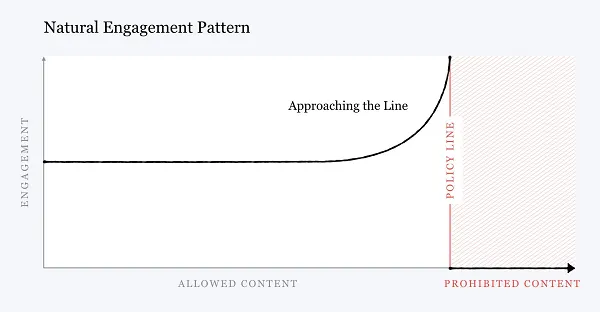
And yet, in January 2025, Zuckerberg changed his tone. In a post about Meta’s move away from fact-checking, he argued that the company has an obligation to allow more speech, and facilitate more discussion on borderline topics. As a result, Meta then relaxed some of its rules that had previously restricted the discussion of certain controversial topics, including immigration and gender identity.
By Zuckerberg's own logic, this shift will lead to more polarization, which will result in more harm.
It’s a significant change in perspective, and as social media platforms become even more critical sources of information, it begs the question of why Zuckerberg had a change of heart on this, and decided to go the opposite way allowing more of this discussion, despite acknowledging potential harm.