Meta has shared new data on its compliance with Australia's under-16 teen social media ban, with the company reporting that since June 2025, it has removed access to more than 750,000 Australian accounts across Facebook and Instagram which its systems determined belonged to people below the minimum age.
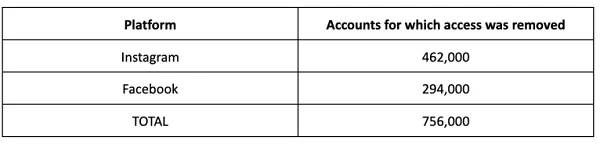
That’s up from the 550,000 teen accounts Meta reported in January. The company has been working to improve its detection and enforcement as Australian authorities increase pressure on social apps to adhere to its new rules.
As per Meta: “Enforcement is ongoing, and these numbers will continue to grow. We report our enforcement to the eSafety Commissioner and will continue to publish updates periodically in order to be transparent with the public.”
Meta said the rise in account enforcement actions was due to the continued improvement of its detection systems, with its artificial intelligence-powered tools in particular catching more teen accounts over time.
“We use AI to analyze profiles — including posts, comments, bios and captions — for contextual clues that an account may belong to someone under 16, such as birthday celebrations or mentions of school grades,” Meta said.
In addition, Meta said it’s also made it easier for parents and the community to report a suspected underage account. The company also ran an educational campaign across both Facebook and Instagram that highlighted how Meta detects and removes under-16 accounts, and what happens to a teen’s account and memories when the account is removed.
Cumulatively, this has led to an increase in enforcement actions. However, the Australian eSafety Commission’s own data showed that, at this stage at least, most under-16s in the nation are still accessing social media apps, despite increased efforts from the platforms and the relevant authorities.
Earlier this month, Australia’s eSafety Commission released a status update on the effectiveness of the under-16 social media ban. The report found that 81.5% of underage users continued to access restricted apps.
The Commission leveled the blame for this primarily at the apps themselves.
“Across age-restricted platforms, the main reason children gave for why they still held an age-restricted account was that the platform hadn’t yet asked them to confirm their age (50.2%) [while] others reported that the platform had incorrectly estimated their age (18.2%),” the Commission said.
As such, the eSafety Commission vowed to increase penalties for apps that failed to comply with the new requirements. Though those requirements also remain fairly vague and open to interpretation.
Meta has repeatedly highlighted this as a problem, and has called for more uniform enforcement across the board to ensure a level playing field.
“Our primary concern is that platforms are not taking a consistent approach to how they are removing teens,” Meta said in its latest update. “There should be a single reliable age signal delivered at the operating system or app store level. Age could be verified once, when a young person sets up their device or downloads an app, rather than repeatedly across the dozens of apps they use.”
Meta has repeatedly said that app store-level age verification and uniform guidance are more effective approaches than having individual platforms enact their own age-checking processes.
Thus far, however, the eSafety Commission has tagged early concerns as part of the initial implementation period, and said that it will take some time to see the true effect of the restrictions.
In addition to failures in enforcement, the Commission’s update also said that most children saw no improvement in negative impacts associated with problematic online use.