Meta has shared some new insights into how its Your Algorithm control option on Facebook works, which enables users to provide direct input into what content they want to see more or less of in the app.
The tool enables users to add or remove specific topics from an automatically generated list of interests, which Facebook's system has built based on each user's in-app actions. In addition to removing and adding topics, users can also now tell the algorithm specifically what they want to see more of, via a recently added chatbot prompt.
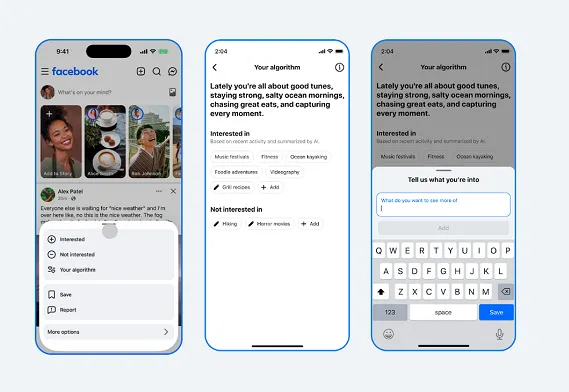
Conceptually, this gives users more ways to refine their Facebook experience.
On the Meta engineering blog, the company has shared notes on how the process works, and explained more about how exactly updating user algorithm preferences can impact in-app experiences.
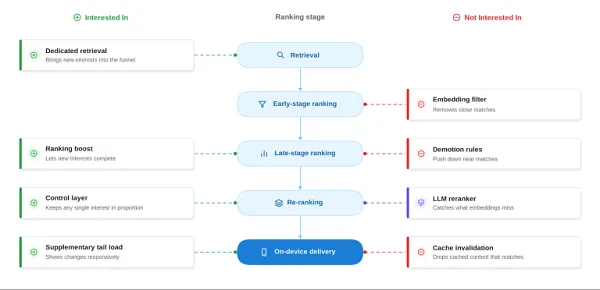
Some key notes:
- When a user adds a new interest, Meta’s system gives those topics extra weight for a limited period to ensure that the user sees the change. After that, these new additions will be weighted based on user interaction, just like with any other topic.
- The system balances exposure across topics to avoid overwhelm on any specific subject.
- Large Language Models generate the user topic profiles and provide checks for any user-made changes to ensure that each one fits into a topic category. As explained by Meta: “An LLM turns interest signals, which are refreshed regularly, into a set of inferred interests with clear, readable topic names.”
In addition to these topic-related notes, Meta said the system also used demotion rules to enact more general parameters that don’t relate to a specific topic.
“Quality-related requests, such as reducing AI-generated or sexually suggestive content, map to dedicated demotion signals rather than topic matching,” Meta said.
These demotion rules work differently than topic ranking, with the system using these as indicators to reduce these elements.
“During ranking, the same embedding-based comparison used in the relevance check removes candidates too close to an interest in Not Interested In, and demotion rules push down near matches,” Meta said.
In other words, this feature can reduce the presence of artificial intelligence-generated content in a user’s Facebook feed, though it won’t get rid of that entirely, and ranking will still be influenced by future engagement.
When a user requests less content from a specific creator, however, “that creator’s content is filtered out directly,” Meta said.
These notes provide more insight into how Meta plans to facilitate algorithm customization and give users more control over their in-app experiences.
Meta’s hope is that through tools like this, users will feel more empowered in the app. In turn, that may quell ongoing calls for the platform to return to a reverse chronological feed and remove ranking elements entirely.
Given that algorithmic amplification has continued to drive up Facebook and Instagram usage, Meta is very keen to keep that in place.
Though the company may not have a choice. Last month, the Australian government began preliminary investigations into potential new laws that would force social media platforms to provide users with an option to switch off algorithmic recommendations and set non-algorithmic feeds as the default.
A growing body of research suggests that algorithmic amplification can have harmful impacts. If this new push in Australia goes ahead and it ends up showing that the negative impacts of algorithms are reduced, that could lead to more regions exploring similar rules.
As noted, Meta is very keen to avoid this outcome.
Last year on a Q2 earnings call with analysts, Meta CEO Mark Zukerberga said AI recommendations had led to a 5% increase in time spent on Facebook, and a 6% boost on Instagram for the quarter.
On its Q2 earnings call a year later, Zuckerberg said that global time spent on Instagram had grown in the quarter by double digits year over year, and Facebook video time spent had increased by 9% globally, "largely driven by improvements to our feed and Reels recommendations."
It makes sense, then, that Meta is keen to avoid any external push to switch off its algorithmic ranking.
As such, Meta's hoping that the introduction of this control option will ease user concerns. Combine this with the fact that, based on past history, users rarely update their settings, and the company's likely hoping that it can benefit from the perception of control afforded by the tool, while also seeing a minor impact on its business.