Meta has removed the option to use its latest artificial intelligence tools to remix other people’s posts on Instagram, after widespread backlash to the new feature, which all users had been opted into by default.
Last week, Meta announced its latest Muse Image model, its most advanced image and video generation tool to date. As part of that announcement, Meta also announced a new feature that would enable Instagram users to integrate other users' publicly posted content into their AI depictions, by @mentioning profiles within the creation process.
What’s more, Meta also said the feature was enabled for all accounts by default, and that users would have to explicitly opt out of AI remixes in order stop other people from re-using their posts.
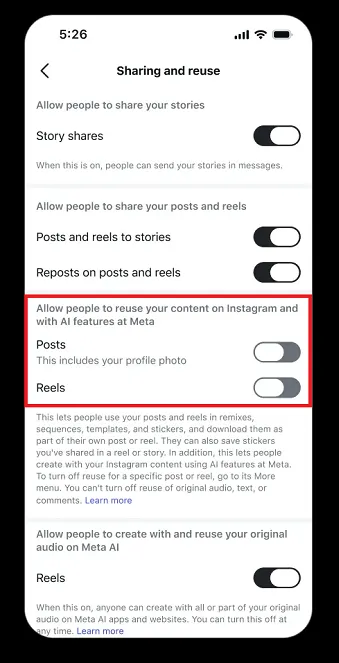
Unsurprisingly, many Instagram users were upset by this, with the potential for misuse seemingly well beyond any positive use of the option.
Variety also reported that various talent agencies immediately raised concerns that the option would facilitate identity theft and misuse, and advised their clients to opt out.
Meta got the message, and just two days later, it announced that the option would be retracted.
As per Meta: “Earlier this week, we announced that one way for people to generate images in Meta AI is by @-mentioning public Instagram accounts that they want to reference. Our intent was to provide a useful creative tool and to give people control over whether their public content could be referenced in this way. We’ve heard the feedback that this feature missed the mark, so it’s no longer available.”
The fact that Meta moved so fast to remove the option is a good thing, and shows that Meta is paying attention.
But the idea that this was ever enabled in the first place raises serious questions about Meta’s innovation-led approach.
The company has always sought to push the envelope. Indeed, Facebook’s original internal motto was “move fast and break things,” which is a summation of an approach that has since led to significant concerns regarding data privacy, harm to children, social media addiction and the weaponization of social media as a political device.
On balance, it’s difficult to argue that social media has been a positive for society, despite its connective benefits. Yet, many of the negative impacts could have been addressed earlier if platforms, including Meta, had taken a more responsible approach.
But because the extent of social media’s potential for harm wasn’t fully understood early on, Meta, and other companies pushed to attract more users, and keep them coming back, while also winning over more ad dollars.
Now, some two decades into the social media era, the potential harm caused by these platforms is better recognized, and as such, platforms should be able to apply safeguards to any new developments, including VR and AI, before they push new tools out at scale.
Though evidently, Meta isn't going to police itself.
In fact, Meta has been working to establish closer ties with the Trump Administration in the hopes of gaining governmental support in opposing regulations designed to mitigate future harms.
The main example here is Europe, where the EU Commission continues to roll out restrictions on data usage and evolving social platform features. The EU Commission, for example, forced Meta to delay the rollout of its AI chatbot tools to EU users until the Commission could assess the impacts. These regulations are designed to better assess any potential for harm and protect EU users.
As a result of its regulatory approach, the EU has fined Meta more than $1 billion per year over the past three years due to violations, which is why Meta is hoping to push back, while the company also wants to expand the availability of its AI tools and other features to more users.
Meta views any regulatory delays or restrictions as an obstruction of its business goals, and therefore as a potential limitation of its revenue opportunities. But clearly, given Meta’s willingness to push out potentially harmful AI tools with little consideration for the impacts, it does seem like the EU approach does have merit.
The U.S. government, meanwhile, is keen to support AI projects in order to ensure that the U.S. leads the AI race, and has approved the removal of red tape to push ahead with new tools.
But given blatant errors in judgment like this, can Meta actually be trusted to manage the release of such systems?
What happens when people get addicted to an AI chatbot, for example? How does AI interactivity impact people’s mental state? How does it impact society as a whole?
There are significant concerns that have seemingly been swept aside in favor of progress, which this latest example demonstrating, once again, blatant, ignorant advancement without consideration of the potential for harm.
In ten years’ time, society may be looking back on this moment and asking why more caution wasn’t taken, and why more features like this weren’t held back.