This is interesting.
Amid all of the wrangling over social media age checking, and who should be responsible for such, as more regions implement and/or consider stricter limits for social media use, it seems that Snapchat may have found a way to work with Apple on a more universal age-checking process.
According to Snap, it’s now using Apple’s “Age Range” qualifiers to detect underage users.
As per Snap:
“On Apple devices running iOS 26 or later, Age Range for Apps shares your age range with apps to help keep experiences age-appropriate. If you are 13 or older, you can set this feature up yourself. If you are under a Family Sharing group, a parent or guardian will need to help manage your age range and related controls in Family Sharing settings.”
With Apple’s Age Range process, parents are able to share their child’s age information, and require permission for app download requests based on such.
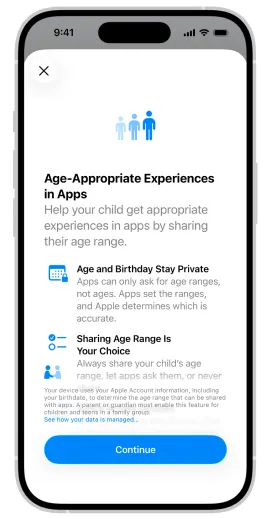
These age range brackets are based on Apple’s app age rating system, which it updated in February in order to provide more granular categorization for apps, especially among teen audiences.
And now, Snapchat’s using this as a qualifier to help ensure that young users are kept out of its app.
“When you sign up for Snapchat, log into your account, or open the app, you may see a prompt to share your age range. Only your age range is shared by Apple; never your exact birthday. If your age range meets the minimum age requirements to use Snapchat, you’ll be able to continue as usual. If your age range is under the local minimum, you will not be able to access Snapchat.”
Snap further notes that if users don’t share their age, and local law requires it, they may be prompted to verify their age via k-ID.
k-ID provides third party age verification for younger users, and will also soon be used by Meta to confirm user ages.
So, Snap now has an age checking process, verified by Apple, and backed up by a third party tool, that will better enable it to detect and reject underage users. Which all social apps need to have, with more regions considering tougher laws on teen access, and harsher penalties for violations.
But what’s interesting in this case is that this sounds very much like the exact age-checking process that Meta has been calling on Apple to implement, with Apple able to check user ages at the download level, thereby eliminating the need for each platform to implement their own age-checking systems.
As it currently stands, the onus is on the platforms to check user ages, and block young users from their apps. This means that there's a range of different age-checking processes at play, some more effective than others, which also puts all the onus on the platforms, at risk of financial penalties if they fail.
But Meta has proposed that Apple and Google are better placed to do this, at the app store level, because they can implement more universal age checks that would then be applied to all apps downloaded by the user, as opposed to passing users through multiple age checks in multiple apps.
If this were centralized at the download stage, then all apps would be held to the same standards, yet that would also mean that any penalties for violations would be passed onto Apple and Google instead, which neither obviously wants to take on.
And they’ve been successful thus far at avoiding such, and passing the buck to the apps instead. But this process shows that Apple is able to facilitate age checking, at a broader scale, and that this process could be a more effective barrier to young user access.
Of course, Apple will argue that its age range qualifiers are just that, ranges, which can’t definitively exclude users of a specific age, while it’s also not compulsory, with parents opting into this process.
But it certainly seems like Apple could make it compulsory, and could implement broad-scale age checking at the download level, which would mean that all social apps can be cut off for users under a certain age at a single entry point.
Of course, that wouldn’t stop users who’ve already downloaded these apps from using them. But for future users, it could be a more universal, practical approach to app access restrictions, which makes it easier to manage, and implement restrictions based on age.
As Meta has argued, it makes more sense to implement such blocks at this level, scaling restrictions for all users under the same parameters. And it seems like Apple can do this, which would lessen the burden on the apps themselves to come up with similar measures.