Despite various objections to the process, and after repeatedly seeking to have its platform exempted from Australia’s coming social media access restrictions for teens, YouTube is now alerting Australian users that anyone aged under 16 will be locked out of the app on December 10th, when the new social media age laws come into effect.
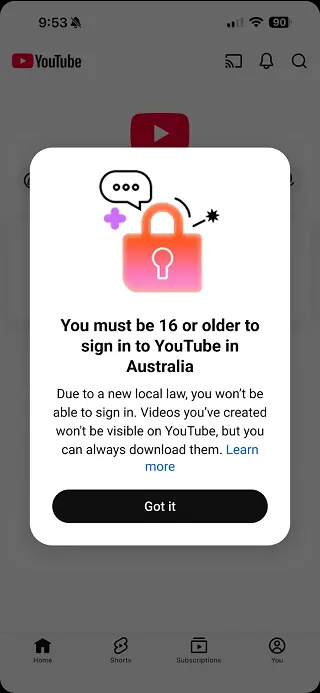
As you can see in this example, Australian teens aged under 16 will soon be faced with this message when they go to log into the app, cutting them off from YouTube pending relevant age checks.
That will see millions of users locked out of the app, though most Australian teens seem confident that they’ll still be able to find workarounds, and access social apps through other means.
The Australian government announced its higher social media age restrictions last year, with YouTube initially excluded from the new law due, in part, to its educational value. But after lobbying from Australia’s eSafety Commissioner, YouTube was re-added to the list of restricted sites back in July, a decision that YouTube has railed against, by highlighting its value, in various ways, to young users, while also seeking to separate itself from other social-focused apps.
But YouTube will be restricted under the new law, which will mean that the platform needs to implement more stringent checks to keep young teens out of the app.
As per YouTube:
“Due to a new law in Australia, the minimum age required to sign in to YouTube in Australia is 16. This means that starting on 10 December 2025, users under 16 years old will be automatically signed out from YouTube. This includes any supervised pre-teen and teen accounts.”
YouTube says that signed-out users will still be able to view YouTube content (that’s not age-restricted), but they won’t be able to like and subscribe in the app.
Younger teens will also lose access to their YouTube channels, as well as any monetization opportunities.
YouTube says that users can download their data, and delete their account if they choose. Or they can wait to be reinstated when they turn 16, in compliance with the new laws.
Which, presumably, a lot of younger teens will do, with the impact of these new restrictions likely to have a bigger effect on the next generation of teens, who’ll grow up with these new thresholds in place.
Though as YouTube has argued, the new laws might not have the impact that Australian regulators are hoping.
“At YouTube, we believe in protecting kids in the digital world, not from the digital world. That’s why we’ve invested for more than a decade in consultation with child development experts to build age-appropriate products for our youngest users, like YouTube Kids, supervised experiences for teens and tweens, default wellbeing settings for all teens and robust parental controls. As the Social Media Minimum Age Act requires kids to use YouTube without an account, it removes the very parental controls and safety filters built to protect them - it will not make kids safer on our platform.”
YouTube says that the new laws have stemmed from “a rushed legislative process” which failed to allow for adequate consultation and consideration of the real complexities of online safety regulation.
“The law also fundamentally misunderstands why teens come to YouTube in the first place. YouTube is a video streaming service where they come to watch and learn– everything from 'how to tie a tie' videos, to famous speeches, to newsmaking podcasts, to live concerts, to epic sports highlights. And increasingly, kids, teens and families are watching YouTube on television screens in their living room.”
YouTube says that it’s committed to finding a better path forward, and will continue to work with the Australian Government to advocate for “effective, evidence-based regulation that actually protects kids and teens, respects parental choice, and avoids unintended consequences.”
It’s hard to say what’s going to happen as a result of these increased social media age limits, but the likely outcome will be that teens will either find workarounds to keep accessing these apps (I’m in Australian and I have teenage children, and they seem confident that this will be the case), or they’ll migrate to other apps and spaces instead.
Indeed, reports have suggested that Australian teens are already shifting to ByteDance-owned Lemon8, as well as photo-sharing app Yope, instead.
And with decentralized social media options also available, it does seem like teens will find a way, but you can also bet that Australian regulators will be watching on, and looking for any potential gaps.
Though I maintain that the biggest flaw remains the lack of a defined age-checking process, with each platform simply told to do their best, essentially, to align with the new rules. That seems too vague for effective prosecution, and it’ll be interesting to see just how hard it is for teens to subvert these new restrictions, and how the government then seeks to penalize platforms that fail to keep youngsters out.