Social media engagement has changed a lot over the past five years, with the rise of short-form video and algorithmic-defined recommendations, turning social apps from connective tools, with which to connect and engage with friends and family, into entertainment alternatives.
That’s important to note for brand strategists and marketers, because the actual reason why people use social media has changed. They’re no longer looking to engage with brands via posts and uploads, and text updates with a few hashtags won’t do it.
In order to connect, brands need to also shift into the entertainment mindset, which, in alignment with defined branding pillars, means outlining a more consistent approach to brand building through dedicated formats.
Association via consistent messaging can be a big driver of brand opportunity.
That’s the focus of a new brand strategy outlined by Mondo Metrics founder Nick Cicero, who’s spent two decades working in social media marketing, primarily focused on improved metric analysis and optimization.
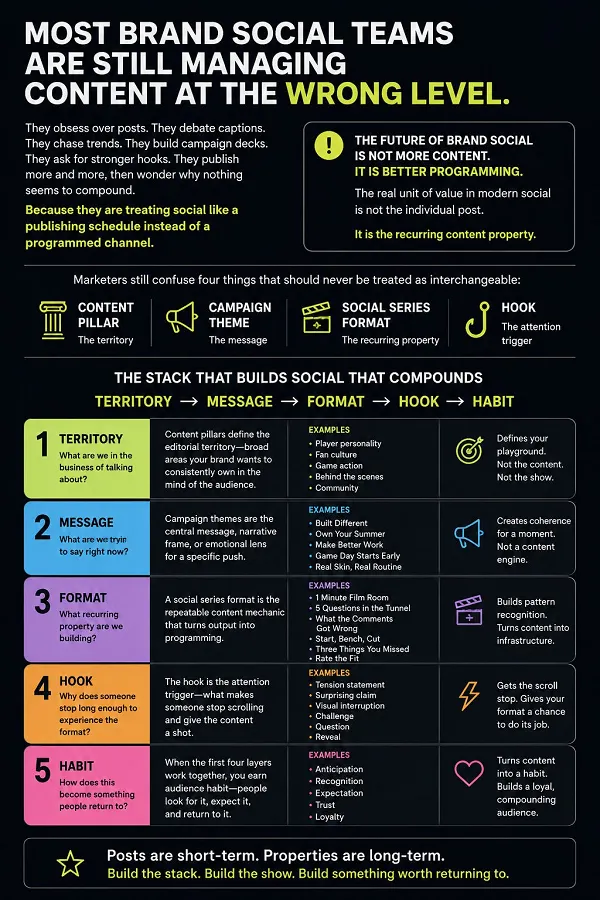
Cicero knows digital marketing trends, and based on his insights, he has established a framework for brand building in the modern social media landscape, which is based on defining a message, and underlining that consistently, in order to embed brand association and engagement.
As per Cicero: “The brands that will win are not just the ones with the most output, the fastest editors, or the best trend reflexes. They are the ones that understand the real unit of value in modern social is not the individual post. It is the recurring content property.”
Cicero said that a repeatable format, recognizable packaging, consistent talent or premise, and structural familiarity will help an audience build a relationship with a brand, and come to expect their content in their feeds..
Cicero said that the content strategy approach can be broken down in to four key elements:
- Territory – This defines the broad areas that a brand wants to own in the mind of their audience. As an example, a sports brand may want to focus on fan culture, while a B2B brand could make executive insights their focus.
- Message – The core message that brands want to underline with their content approach. Understanding the value of a brand’s offerings to their consumers is key here, so it’s important to consider why a product is important and what it helps to address in the users’ life.
- Format – Cicero said that a dedicated approach to a content format, like a regular interview series, or explainer overviews of technical elements, will help to reinforce brand association, and habitual engagement
- Hook – Finally, a content series needs a hook, though Cicero is keen to note that brands need to also follow-up on that initial hook to build community and audience.
Using this as a foundation, Cicero advises that marketers establish this approach as their guiding star, and commit to creating content along this line in order to build habitual engagement with the target audience.
Cicero said that using entertainment as the focus, in alignment with these branding elements, will reinforce core messaging, and help to establish brand placement and value.
That, again, is more in line with modern social media usage, in that people are no longer as focused on connection and friend engagement, but are increasingly using social apps as an entertainment source, with recommended videos rolling through their feeds.
Aligning with this, with consistent, brand-building content, relevant to a specific need, will help to build that reputation and relationship over time.
Cicero has also put these notes into a helpful infographic, with an easy-to-understand flow of the key ideas.